Why the Best Tropical Homes Are Planned Around Light, Not Layout
In subtropical climates, light is the architecture. Everything else follows. Why the best tropical homes are designed around sun angles before floor plans.
We often spend the first week studying sun angles before we've drawn a single wall. Most clients arrive with floor plans already formed, rooms sketched on grid paper, dimensions noted, a rough sense of how the house should sit. Our first move, gently when possible, is to set those aside and spend time with the sun.
In tropical and subtropical climates, light is not decoration. It is the organising principle. The homes that age best are those planned around light quality before floor plan, where orientation dictates spatial logic rather than the other way around. On the Sunshine Coast, where summer heat arrives from the west and winter sun tracks low across the northern sky, the consequences of getting this wrong are immediate and lasting.
This is not abstract theory. It is what we have observed, built, and lived with.
The western view problem, and the eastern exposure trap
A common brief: the site has hinterland views to the west, ocean glimpses to the east. The instinct is to open the living spaces west, toward the escarpment and the Glass House Mountains. The problem is the afternoon sun.
Between November and March, that western façade becomes a heat engine. By 3pm, direct sun is hitting glazing at a low, punishing angle. Even high-performance glass cannot mitigate the sheer thermal load. The view becomes a liability. Blinds stay drawn. The room overheats. The air conditioning runs constantly.
The eastern exposure, meanwhile, offers morning light, softer, cooler, filtered through coastal haze, and the opportunity for some of the best Ocean views imagainable. The early sun warms timber floors without the aggressive heat of afternoon. By midday, the east façade is in shade. On exposed coastal sites, badly oriented windows will punish you daily. The morning side rarely does.
This does not mean abandoning the hinterland view. It means framing it carefully: smaller apertures, deep reveals, perhaps a narrow vertical slot rather than a full wall of glass. Indoor-outdoor living spaces that open west need to be verandahs, not glasshouses.
Why light must lead layout
The standard approach to residential planning is to begin with programme: how many bedrooms, how the kitchen relates to dining, where the garage sits. These are important questions, but they are not the first questions. In subtropical Queensland, the first question is: where does the sun go?
We map it. Summer solstice, winter solstice, equinox. Morning through to late afternoon. The path across the site changes daily, and the house needs to respond to that rhythm. A north-facing living room in the southern hemisphere receives winter sun all day, desirable, controllable, warm without overheating. South-facing rooms, by contrast, get soft indirect light year-round. Bedrooms on the south can stay cooler in summer. The orientation is not incidental; it is structural.
Clients are frequently surprised by how much the 4pm sun shapes comfort. A poorly planned western bedroom becomes unusable in February.. The layout may look elegant on paper, but if it fights the climate, it will lose.
The honest answer is that we sometimes need to rotate the entire floor plan thirty degrees, or flip the entry sequence, or move the living wing to the opposite side of the site. This is not stubbornness. It is respect for what the sun will do every single day for the life of the building.
Morning sun versus afternoon heat: the asymmetry no one warns you about
In the northern hemisphere, south-facing rooms are prized. In Australia, it is north-facing spaces that collect winter warmth. But even among northern-hemisphere architects working here, the asymmetry between morning and afternoon sun is often underestimated.
Morning sun on the Sunshine Coast, arriving from the east, over the ocean, is mild. The air is still cool from the night. The angle is low but not yet harsh. By contrast, afternoon sun from the west hits a building that has already been warming for six hours, in air that may be 34°C, at an angle that drives deep into the interior. The thermal impact is not symmetrical. Western glazing is a heat-load problem in a way that eastern glazing simply is not.
This is one of the most overlooked aspects of passive solar design in subtropical climates. The morning-afternoon divide is not just about orientation; it is about cumulative heat gain. A home planned around this asymmetry will feel cooler, use less energy, and require fewer mechanical interventions. One that ignores it will rely on air conditioning as a life-support system.
We see this clearly on coastal headland sites. Homes that open generously east and shelter the west perform better in every measurable way. They are lighter, more comfortable, and age more gracefully. The reverse rarely works, no matter how much money is spent on HVAC.
The throughlineThe homes that age best are those planned around light quality before floor plan, where orientation dictates spatial logic rather than the other way around.
Mike Nowson · Atelier Terra
Deep eaves and overhangs: function first, aesthetic second
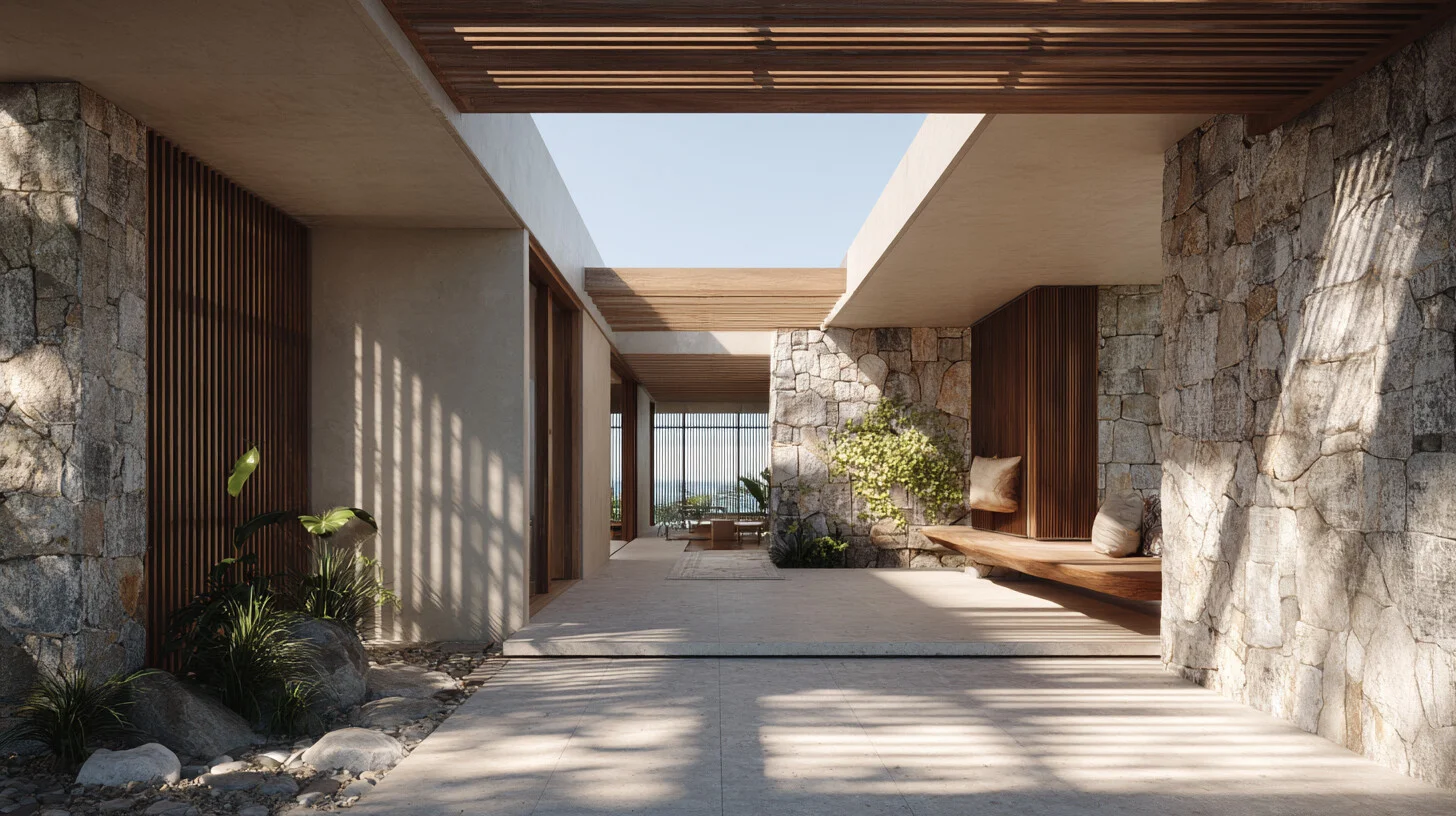
A deep eave is not ornament. It is the building's first line of thermal defence. In subtropical and tropical architecture, the overhang does the work that glass cannot: it stops radiant heat before it enters the building envelope.
The geometry is simple. In summer, when the sun is high, a correctly dimensioned eave will shade the window entirely. In winter, when the sun is lower, it allows light to penetrate and warm the floor slab. This passive modulation, free, permanent, requiring no maintenance, is what separates good tropical design from air-conditioned boxes.
On north-facing elevations, a 900mm to 1200mm overhang will typically achieve this. Western façades, where the afternoon sun is lower and more aggressive, may need deeper protection: 1500mm or more, combined with vertical shading fins or louvred screens. The exact dimension depends on latitude, roof pitch, and the height of the glazing, but the principle is constant: control the heat before it arrives.
We see deep eaves as one of the defining gestures of subtropical residential architecture, not just here, but in vernacular traditions across Southeast Asia, the Mediterranean, and coastal Australia. The form follows the climate. The aesthetic follows the form.
Glazing strategy when the site won't cooperate
Not every site allows perfect orientation. Some blocks are narrow and run east-west. Some have the best view precisely where the worst sun arrives. In these cases, passive design becomes more deliberate, and more interesting.
On constrained sites, we often find ourselves working with layered transparency: a courtyard on the south that brings diffused light deep into the plan; high-level clerestory windows on the north that admit winter sun without compromising privacy; carefully placed skylights that illuminate circulation spines. Good architecture does not require a perfect site. It requires an honest response to the site you have.
Where western glazing is unavoidable, a narrow urban lot, a steeply sloping site that opens only west, we use external shading that can be adjusted seasonally: operable louvres, deciduous planting, deep verandahs that push the glass back into shadow. The goal is not to eliminate the view but to mediate it. A framed aperture rather than a wall of exposure.
Glass technology helps, but it is not a substitute for orientation. Low-E coatings and laminated glazing reduce heat gain, but they cannot reverse it. The best window technology on a badly oriented wall is still fighting the climate every afternoon. This is something we feel strongly about: no amount of specification can fix a flawed site strategy.
What Mediterranean and Balinese architecture understood instinctively
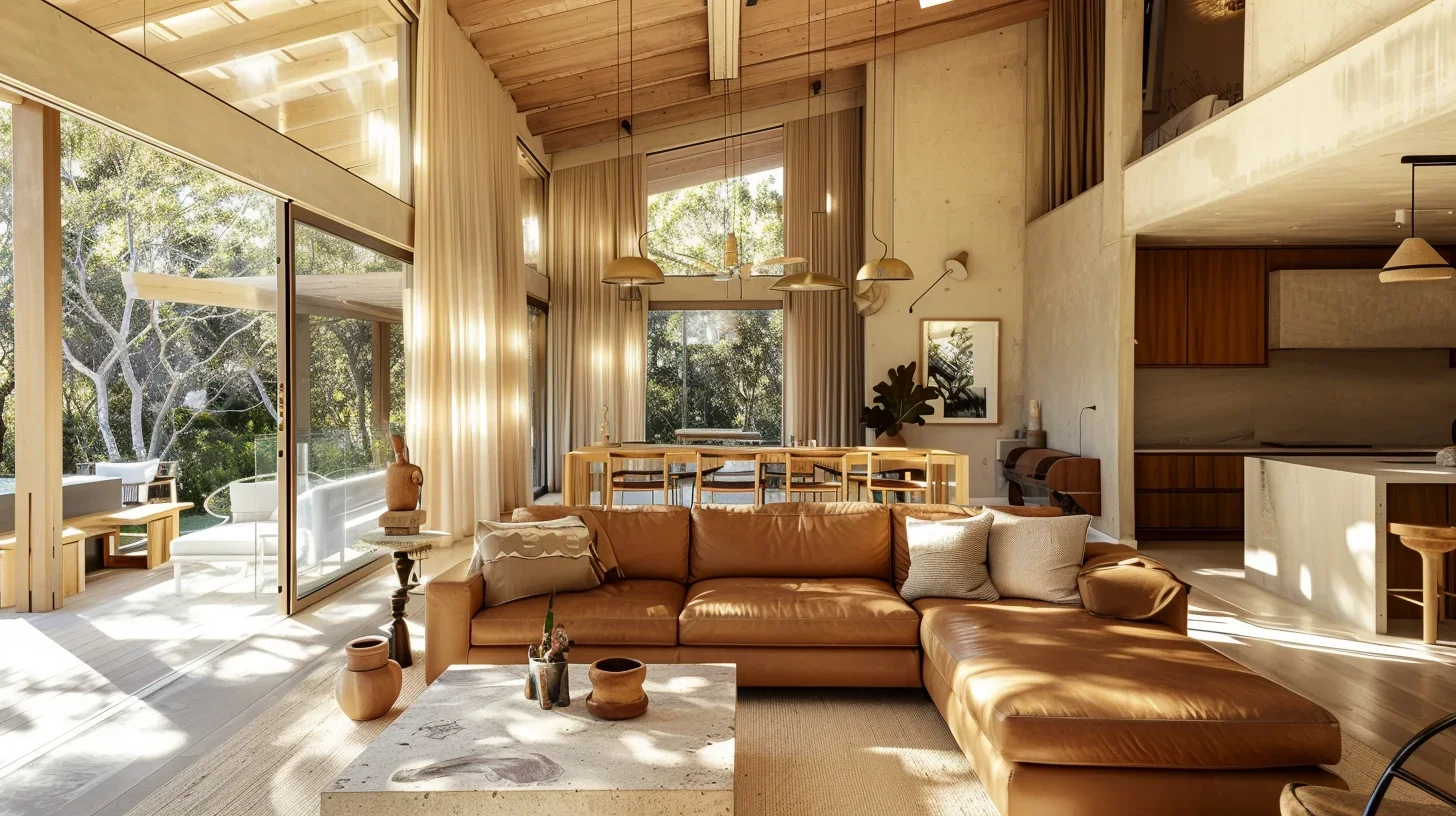
There is nothing new in this. Mediterranean vernacular, thick walls, small apertures on the west, deep loggias, evolved over centuries as a response to summer heat. Balinese pavilion architecture, with its elevated open platforms and layered roofs, was shaped by monsoon rains and equatorial sun. These traditions did not emerge from aesthetic preference. They emerged from necessity.
What they share is an understanding that the building envelope is a filter, not a barrier. Light is admitted selectively. Air moves through. The interior is neither sealed nor fully exposed. In our recent work, particularly on sites with strong Indonesian influence, we have drawn directly from this language: deep overhangs, cross-ventilation, outdoor rooms that mediate between inside and landscape.
The lesson is that tropical and subtropical architecture is not about openness for its own sake. It is about calibrated openness, knowing when to welcome the elements and when to shelter from them. The modernist glass pavilion, imported from temperate Europe, does not translate without significant adaptation. The honest answer is that much of what we now call tropical modernism is really a rediscovery of what vernacular builders knew all along.
On craftDeep eaves are not ornament. They are the building's first line of thermal defence, stopping radiant heat before it enters the envelope.
Mike Nowson · Atelier Terra
Homes designed with time of day in mind
A house planned around light is also a house planned around time. Morning rooms are east-facing: bedrooms, breakfast nooks, home offices that benefit from early clarity. Afternoon spaces are west-sheltered: living rooms that remain cool, outdoor terraces that become usable as the day softens. Evening spaces can open north or south, where the low winter sun can still reach in.
This is not prescriptive. Every household has its own rhythm. But the best client conversations begin with questions about how time is spent: when the family gathers, when quiet is needed, when the house is empty. These patterns, overlaid with the sun's movement, begin to suggest a spatial logic that no generic floor plan can provide.
What few discuss openly is how much this matters to long-term satisfaction. A home that is too hot in the afternoon, too dark in the morning, or reliant on artificial climate control to be comfortable will never feel right, no matter how well it photographs. The inverse is also true: a home that breathes with the day, that adjusts naturally to the season, becomes more loved over time. It is architecture in the oldest sense, shelter tuned to place.
The floor plan is not irrelevant. But it is not the starting point. The sun is the starting point. Everything else follows.